
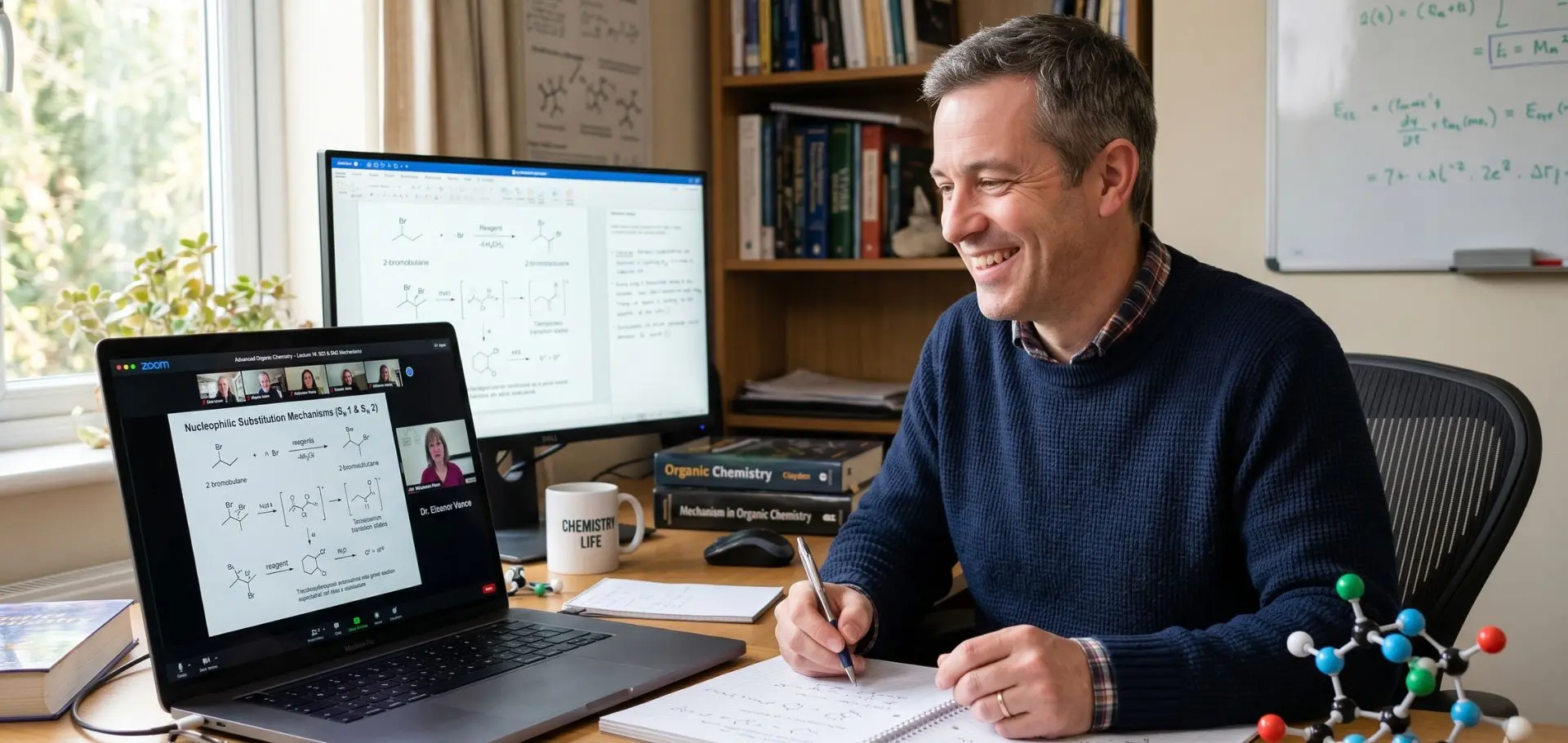
An online organic chemistry course sits near the top of the prerequisite list for most healthcare programs, and finding one that transfers, prepares you for entrance exams, and includes recognized lab experience is harder than it should be. Requirements vary by profession and by individual program. Accreditation standards differ across institutions. Admissions committees have inconsistent policies on whether they accept online science coursework at all.
Southern California University of Health Sciences (SCU) offers Organic Chemistry I (OCHM311) and Organic Chemistry II (OCHM316) through its Accelerated Sciences program. Each is a five-week course with lecture and lab, WSCUC regional accreditation, and three delivery formats: online self-paced, online live, and in-person at SCU’s Whittier, California campus. Browse the full course catalog to see how organic chemistry fits into your complete prerequisite plan.
Which Healthcare Programs Require Organic Chemistry—and How Much
The short answer is most of them, but the details matter more than the generalization. Requirements vary not just by profession but by individual program, and getting this wrong can cost you a full application cycle.
Medical schools have historically required two semesters of organic chemistry with labs. That standard is shifting. A growing number of programs—including some of the most competitive—now accept one semester of organic chemistry paired with one semester of biochemistry. The AAMC’s Medical School Admission Requirements database remains the definitive source for verifying individual school policies.
PA programs most commonly require one semester of organic chemistry with lab. Some programs list it as recommended rather than required, while others require two semesters or accept biochemistry as a substitute for the second. The Tufts PA program, for example, accepts online courses including online labs but notes a preference for traditional face-to-face instruction. The practical advice: treat one semester of organic chemistry with lab as a baseline, and check every target program individually.
SCU also offers its own ARC-PA-accredited Master of Science: Physician Assistant program—a 28-month hybrid program with 10-year accreditation-continued status and guaranteed interview eligibility for qualified BSHS and MSMS graduates.
Dental schools almost universally require two semesters with labs, per standards tracked by the American Dental Education Association. This is one of the most consistent requirements across health professions.
Pharmacy programs typically require two semesters, though some accept one semester plus biochemistry.
Physical therapy and occupational therapy programs less frequently require organic chemistry, but enough programs include it that skipping it narrows your options. Research your specific target programs before assuming you can avoid it.
The underlying pattern: organic chemistry requirements are becoming more flexible at the program level, but the safest strategy remains completing at least one full sequence (Organic Chemistry I + II with labs) unless you’ve verified that your specific target programs accept an alternative.
The Online Acceptance Question
Besides your grade at the end of the term, this is the most consequential question in your academic decision—and the answer is more nuanced than most guides acknowledge.
The current landscape is a patchwork. Many programs expanded online acceptance during 2020–2021 and have maintained that flexibility. Others reverted to pre-pandemic policies that prefer or require in-person science coursework. A third group evaluates online courses case-by-case, weighing institutional accreditation, lab format, and course rigor.
What matters most to admissions committees:
- Regional accreditation of the offering institution. This is the threshold requirement. Programs that accept online coursework almost universally require it from regionally accredited institutions (WSCUC, HLC, NECHE, SACSCOC, etc.). SCU holds WSCUC accreditation—the same body that accredits the University of California and California State University systems.
- Lab format and documentation. Some programs accept virtual labs; others prefer or require hands-on components. A few don’t specify. SCU offers online self-paced labs and in-person labs at the Whittier campus, and records all formats identically on transcripts with no notation of delivery method.
- Course level and rigor. Admissions committees at competitive programs distinguish between courses designed for science majors and those aimed at non-majors. SCU’s organic chemistry sequence is designed for health sciences students and covers the full scope of topics expected by professional programs.
What you should do before enrolling: Contact each target program’s admissions office directly. Ask whether they accept online organic chemistry, whether they have lab format preferences, and whether they accept courses from SCU specifically. A five-minute phone call can prevent months of wasted effort. You can also review the list of 800+ institutions where students have successfully transferred SCU Accelerated Sciences credits to see if your target program is already on record.
What Five Weeks of Organic Chemistry Actually Looks Like
The accelerated format deserves an honest description because it isn’t for everyone.
Five weeks of organic chemistry requires approximately 20 to 25 hours of focused study per week. That’s the same total contact time and workload as a traditional semester—compressed into daily immersion rather than weekly lectures. You’ll engage with reaction mechanisms, molecular modeling, problem sets, and lab work every day.
The advantage: Continuous daily exposure to organic chemistry concepts tends to strengthen pattern recognition and retention. Students aren’t losing momentum between weekly class meetings or cramming before midterms after weeks of partial attention.
The reality check: Missing two days in a five-week course is equivalent to missing two weeks in a traditional semester. There’s no coasting. If your current life circumstances include a demanding full-time job, significant caregiving responsibilities, or other intensive commitments, spacing the courses out by one five-week session between Organic Chemistry I and II may be more realistic than running them back-to-back.
The format rewards disciplined, consistent daily work. If that matches how you learn best, the accelerated timeline is a genuine advantage. If it doesn’t, SCU’s continuous enrollment means you can start any session and pace the sequence to your situation.
What Professional Schools Actually Think About Online Organic Chemistry
Most programs now evaluate online courses based on institutional accreditation and curriculum rigor rather than delivery format. According to the American Association of Medical Colleges, medical schools focus on whether courses meet learning objectives—not where students physically sit.
However, many programs still maintain preferences for in-person coursework, particularly for core science prerequisites. Before the COVID-19 pandemic, most medical schools discouraged or rejected online prerequisites. While many programs temporarily accepted online coursework during 2020-2021, acceptance policies vary significantly by institution. Research your specific target programs’ current policies. SCU’s WASC accreditation places courses on par with University of California campuses and other major institutions.
The Five-Week Organic Chemistry Experience
A five-week organic chemistry course at SCU requires approximately 20-25 hours weekly—equivalent to semester-long courses, just concentrated. Daily immersion in reaction mechanisms and molecular structures reinforces concepts continuously rather than weekly.
The advantage? Students report improved retention compared to cramming before semester exams.
The challenge? You cannot fall behind. Missing two days in five weeks equals missing two weeks in a traditional semester. This format rewards disciplined, consistent daily work.
Organic Chemistry Sequence: I, II, and Biochemistry
Most healthcare students complete Organic Chemistry I, Organic Chemistry II, and biochemistry.
Organic Chemistry I covers molecular structure, stereochemistry, acid-base reactions, and carbonyl chemistry foundations.
Organic Chemistry II advances into synthesis strategies, aromatic chemistry, reaction mechanisms, and spectroscopy—directly preparing for biochemistry and MCAT organic sections.
Biochemistry connects organic principles to biological systems through metabolic pathways, enzyme mechanisms, and molecular biology. Many professional schools now value biochemistry over a second organic chemistry semester for its clinical relevance.
Preparing for the MCAT and Professional School Entrance Exams
The MCAT dedicates approximately 15% of its Chemical and Physical Foundations section to organic chemistry—roughly 9-10 questions testing reaction mechanisms, molecular structure, and spectroscopy.
Organic chemistry appears throughout biochemistry questions too. Understanding nucleophilic substitution helps grasp enzyme mechanisms. Recognizing carbonyl reactivity explains metabolic pathways.
Students completing online organic chemistry through accredited programs perform comparably on the MCAT to traditional course students. The variable isn’t delivery format—it’s mastery of core concepts and MCAT-style problem practice.
Building the Chemistry Prerequisite Sequence Strategically
Organic chemistry doesn’t stand alone. It sits in the middle of a chemistry sequence, and the courses before and after it affect both your comprehension and your application.
Before organic chemistry: Complete General Chemistry I (CHEM211) and General Chemistry II (CHEM216). Students who enter organic chemistry without solid command of bonding, molecular geometry, acid-base equilibria, and thermodynamics struggle with the pace of organic reaction mechanisms. If your general chemistry courses are more than five to seven years old, consider retaking them. SCU offers Intro to Chemistry (CHEM110) as a refresher starting point.
After organic chemistry: Most health profession programs require or strongly recommend Biochemistry (BIO322). Taking it immediately after Organic Chemistry II capitalizes on momentum, since the metabolic pathways and enzyme mechanisms in biochemistry draw directly on the reaction logic you just spent ten weeks building.
The full chemistry pathway at SCU: Intro to Chemistry → General Chemistry I → General Chemistry II → Organic Chemistry I → Organic Chemistry II → Biochemistry. Completed consecutively, that’s thirty weeks. At a traditional university following a semester calendar, the same sequence takes three academic years.
Complete Your Organic Chemistry Prerequisite With SCU
Organic chemistry is one of the highest-stakes prerequisites on any health profession application. The course demands real intellectual effort, the accreditation behind it matters to admissions committees, and the timeline for completing it shapes when you can apply.
SCU’s Organic Chemistry I and Organic Chemistry II deliver the full two-semester sequence in ten weeks, with WSCUC regional accreditation, flexible lab formats, all-inclusive tuition, and transcripts that don’t differentiate by delivery method. Contact an SCU Accelerated Sciences advisor to confirm course transfers to your target programs and plan your complete prerequisite sequence.
Frequently Asked Questions
Do professional schools accept online organic chemistry courses?
Acceptance varies significantly by program. Many medical, PA, dental, and pharmacy programs now accept online organic chemistry from regionally accredited institutions, though many still prefer or require in-person coursework for core science prerequisites. Some programs explicitly state they don’t accept online science courses, while others evaluate them case-by-case. Always verify your specific target programs’ current policies through the AAMC Medical School Admission Requirements database. SCU’s WASC accreditation meets acceptance criteria for programs that do accept online coursework.
Can I complete organic chemistry in five weeks and actually learn the material?
Yes, with consistent daily effort. Five-week courses require 20-25 hours weekly—the same total commitment as semester-long courses. The accelerated format demands discipline but often improves retention through daily immersion.
How do online labs work for organic chemistry?
Online labs use virtual simulation software replicating reaction outcomes, spectroscopy results, and laboratory techniques. SCU also offers on-ground labs at their Whittier campus. Both formats satisfy professional school lab requirements.
Should I take Organic Chemistry I and II back-to-back or space them out?
Consecutive courses (ten weeks total) capitalize on momentum and retention. However, spacing them by one five-week session provides a brief break while keeping concepts relatively fresh.
What’s the difference between organic chemistry and biochemistry for professional school requirements?
Organic chemistry focuses on carbon-based molecular reactions. Biochemistry applies those principles to biological systems. Many schools now accept one semester of organic chemistry plus biochemistry instead of two organic chemistry semesters.
Will accelerated organic chemistry prepare me adequately for the MCAT?
Yes. MCAT preparation depends on mastering core concepts and practicing MCAT-style questions—not course length. Students completing five-week courses perform comparably to semester-long course students when they dedicate time to MCAT practice materials.