
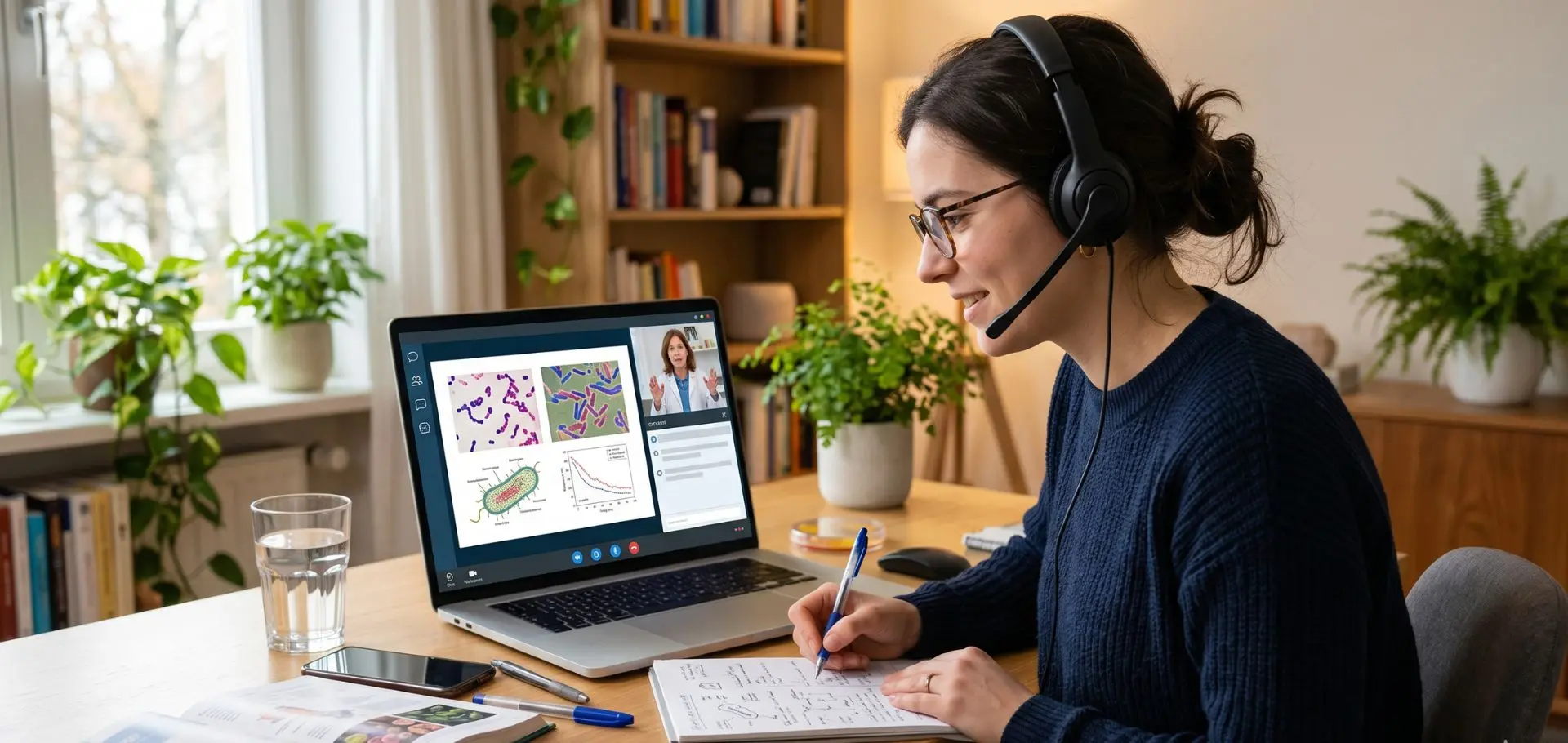
Completing prerequisite coursework online never feels quite straightforward. Whether you’re juggling work schedules around evening classes, managing family obligations that don’t pause for traditional semesters, or living hours away from the nearest campus, microbiology requirements become the bottleneck that delays everything else.
Southern California University of Health Sciences (SCU) offers Microbiology through its Accelerated Sciences program as two separate courses: a 3-credit lecture (BIO231) and a 1-credit lab (BIO231L), each completed in five weeks. Three lab format options are available, and WSCUC regional accreditation supports broad transferability. Before exploring what makes those courses worth considering, it’s worth understanding what you should evaluate in any online microbiology program.
Understanding Online Microbiology Course Requirements
Microbiology sits at the intersection of multiple health science disciplines. The subject encompasses:
- Bacterial pathogenesis and antimicrobial resistance mechanisms
- Viral replication strategies and host interactions
- Fungal infections and mycological diagnostics
- Immunological responses and vaccine development
- Laboratory culture techniques and identification protocols
Most health profession programs require a 4-credit microbiology course that combines lecture with laboratory components. The lecture portion covers microbial diversity, cellular structure and function, metabolism, genetics, and pathogenic mechanisms. The separate lab portion includes includes culture techniques, staining procedures, microscopy, and diagnostic testing methods.
Recent research indicates fewer than 17% of students entering health profession programs have completed undergraduate microbiology coursework, creating knowledge gaps that impact performance in graduate-level curricula.
Why Accreditation Type Determines Whether Your Credits Transfer
This is the single most important factor in choosing an online microbiology course, and it’s the one most frequently misunderstood. Not all accreditation is equal.
Regional accreditation (from bodies like WSCUC, HLC, NECHE, MSCHE, SACSCOC, or NWCCU) is the standard that virtually every nursing school, PA program, and medical school recognizes. Credits from regionally accredited institutions transfer with minimal friction. SCU holds regional accreditation through the WASC Senior College and University Commission (WSCUC)—the same body that accredits the University of California and California State University systems.
National accreditation is a different category entirely. While legitimate, nationally accredited institutions often face transfer restrictions at regionally accredited universities and graduate programs. Credits may not be accepted, or they may require additional review that delays your application.
ACE credit recommendations (used by providers like StraighterLine and Sophia) are a third tier. ACE-recommended courses can transfer to partner institutions, but acceptance is not guaranteed at schools outside those partnerships—and many competitive health programs don’t accept them for prerequisite credit.
The practical takeaway: before enrolling in any online microbiology course, confirm that the offering institution holds regional accreditation and that your specific target program accepts credits from that institution. A quick call to your target program’s admissions office can save months of wasted time.
The Lab Format Question: Virtual, Hybrid, or In-Person
Lab format is where online microbiology courses diverge most significantly—and where admissions committees pay close attention. Here’s what you need to know about each option.
Virtual (asynchronous) labs use simulation platforms to replicate hands-on microbiology techniques. Students perform virtual Gram staining, bacterial identification, culture plating, and susceptibility testing through interactive software. This format offers maximum flexibility—no scheduled times, no location constraints. The limitation is that some programs, particularly competitive PA and medical programs, may prefer or require a hands-on lab component.
Live virtual labs (synchronous) meet at scheduled times via Zoom or similar platforms. An instructor demonstrates techniques in real time and students participate in guided exercises, ask questions, and interact with classmates. This bridges the gap between convenience and interactivity.
In-person labs remain the gold standard for programs that scrutinize lab format closely. Students work with physical culture media, real bacterial samples, actual microscopes, and staining reagents in a dedicated lab facility.
SCU’s Microbiology (BIO231) offers all three options—and lets students mix and match. You can pair a self-paced online lecture with any of the three lab formats:
- Online self-paced lecture + online self-paced lab — maximum flexibility, no scheduled class times
- Online self-paced lecture + online live lab — self-paced lecture content with synchronous lab sessions (Saturdays and Sundays, 2:00–5:00 PM PT)
- Online self-paced lecture + in-person lab — self-paced lecture content with hands-on lab at SCU’s Whittier, California campus (Saturdays and Sundays, 2:00–5:00 PM PT)
Critically, SCU records all formats identically on official transcripts. There is no notation indicating whether a student completed lab work online or in person—a meaningful advantage for students concerned about admissions perception.
Flexible Learning Formats for Working Professionals
Modern online microbiology courses recognize that adult learners often balance education with existing career and family responsibilities:
Self-Paced Learning Asynchronous courses allow students to progress through material according to their individual schedules. Key benefits include:
- Lectures available 24/7 for flexible access
- Assignments completed during convenient time blocks
- Examinations scheduled within specified windows
- No mandatory attendance requirements
Accelerated Timelines Intensive 5-week courses cover the same material as traditional 15-week semesters through focused daily engagement. This format appeals to students who prefer concentrated learning periods rather than extended time commitments.
Live Virtual Instruction Synchronous online classes provide real-time interaction with instructors and classmates while eliminating commute requirements.
SCU’s microbiology courses operate on an accelerated 5-week timeline with options for self-paced online learning, live virtual sessions, or in-person attendance (for labs only).
Getting Started With Your Microbiology Prerequisites
Successful completion of online microbiology requires careful planning and realistic time management:
Time Investment: Most students find that 15-20 hours per week dedicated to coursework ensures thorough understanding of complex material, including:
- Lecture review and note-taking
- Laboratory activities and reports
- Reading assignments and research
- Examination preparation and review
Learning Style Considerations:
- Self-motivated students often thrive in asynchronous environments with flexible scheduling
- Interactive learners benefit from structured virtual classroom interactions
- Hands-on learners prefer in-person laboratory experiences when available
Academic Planning: Contact academic advisors early to discuss prerequisite planning, transfer credit evaluation, and optimal course sequencing for your intended health profession program.
Ready to Complete Your Microbiology Requirements?
Online microbiology coursework should feel challenging but manageable, we offer you the flexibility to fit your current life circumstances within an environment full of academic rigor to better prepare you for advanced health sciences education.
Whether you choose self-paced learning, virtual classroom participation, or in-person laboratory sessions, SCU’s Accelerated Sciences courses can help you garner the necessary credits to achieve your healthcare goals.
Explore the Microbiology course schedule and register, review the list of institutions where students have transferred SCU credits, or request information to discuss how this course fits your program timeline.
Frequently Asked Questions
Will my target program accept an online microbiology course?
Most accredited nursing, PA, medical, and dental programs now accept online microbiology from regionally accredited institutions. The critical variable is accreditation type—regional accreditation (WSCUC, HLC, NECHE, etc.) is broadly accepted, while national accreditation and ACE credit recommendations face more restrictions. Some programs also have lab format preferences, requiring or preferring hands-on or synchronous lab components over fully asynchronous virtual labs. The only reliable way to confirm is to contact your target program’s admissions office directly and ask about the specific institution and format you’re considering.
What’s the difference between regional accreditation, national accreditation, and ACE credit recommendations?
Regional accreditation (from bodies like WSCUC, HLC, or SACSCOC) is the standard recognized by virtually all universities and graduate health programs. National accreditation is a separate category that often faces transfer restrictions at regionally accredited institutions. ACE credit recommendations (used by providers like StraighterLine) indicate that an outside evaluator considers the course college-level, but acceptance depends entirely on individual institutional agreements—and many competitive health programs don’t participate. SCU holds WSCUC regional accreditation, the same accrediting body that covers the University of California and California State University systems.
Does it matter whether I complete the lab online or in person?
It depends on your target program. Some programs accept virtual labs without restriction; others prefer or require hands-on lab components. The safest approach is to verify your target program’s lab format policy before enrolling. SCU offers three lab format options for Microbiology (BIO231)—online self-paced, online live via Zoom, and in-person at the Whittier campus—and records all formats identically on transcripts with no indication of delivery method.
How long does an online microbiology course take to complete?
Traditional semester-length courses run 15 to 16 weeks. Accelerated programs compress the same material into shorter windows—SCU’s Microbiology (BIO231) runs five weeks with new sessions starting continuously throughout the year. The accelerated pace requires approximately 15 to 20 hours of study per week but allows students to complete a four-credit prerequisite in roughly one-third the time of a traditional semester.
What does SCU’s Microbiology course cost, and what’s included?
The combined lecture and lab tuition is $2,120 ($1,590 for the three-credit lecture + $530 for the one-credit lab). That includes the electronic textbook, all lab materials, supplemental study resources, and free tutoring. There are no additional lab kit fees, textbook charges, or proctoring fees. By comparison, programs at other institutions may quote lower per-credit rates but add separate lab kit costs ($200–$400), textbook expenses ($150–$300), and proctoring fees ($25–$50 per exam).
Should I take biology before microbiology?
SCU lists General Biology II (BIO116) as a highly recommended prerequisite for Microbiology (BIO231). While it’s not a hard requirement, students who enter microbiology without a foundation in cellular biology, genetics, and basic biochemistry tend to struggle with the clinical microbiology content—particularly in an accelerated five-week format. If your biology coursework is outdated or incomplete, taking General Biology I (BIO111) and General Biology II (BIO116) first is a strong investment in your success.
Do online microbiology courses expire for prerequisite purposes?
Yes. Most health profession programs require microbiology completed within five to seven years of your application deadline. Some programs enforce stricter three- to five-year limits. If your previous microbiology course has aged out, retaking it through an accelerated program like SCU’s five-week format can refresh the credit on a timeline that keeps your application competitive.
Will my transcript show that I took the course online?
This varies by institution. SCU records all Accelerated Sciences courses identically on official transcripts regardless of whether the student completed the course online (self-paced or live) or in person. There is no notation indicating delivery format—a meaningful advantage for students concerned about how admissions committees may perceive online coursework.