
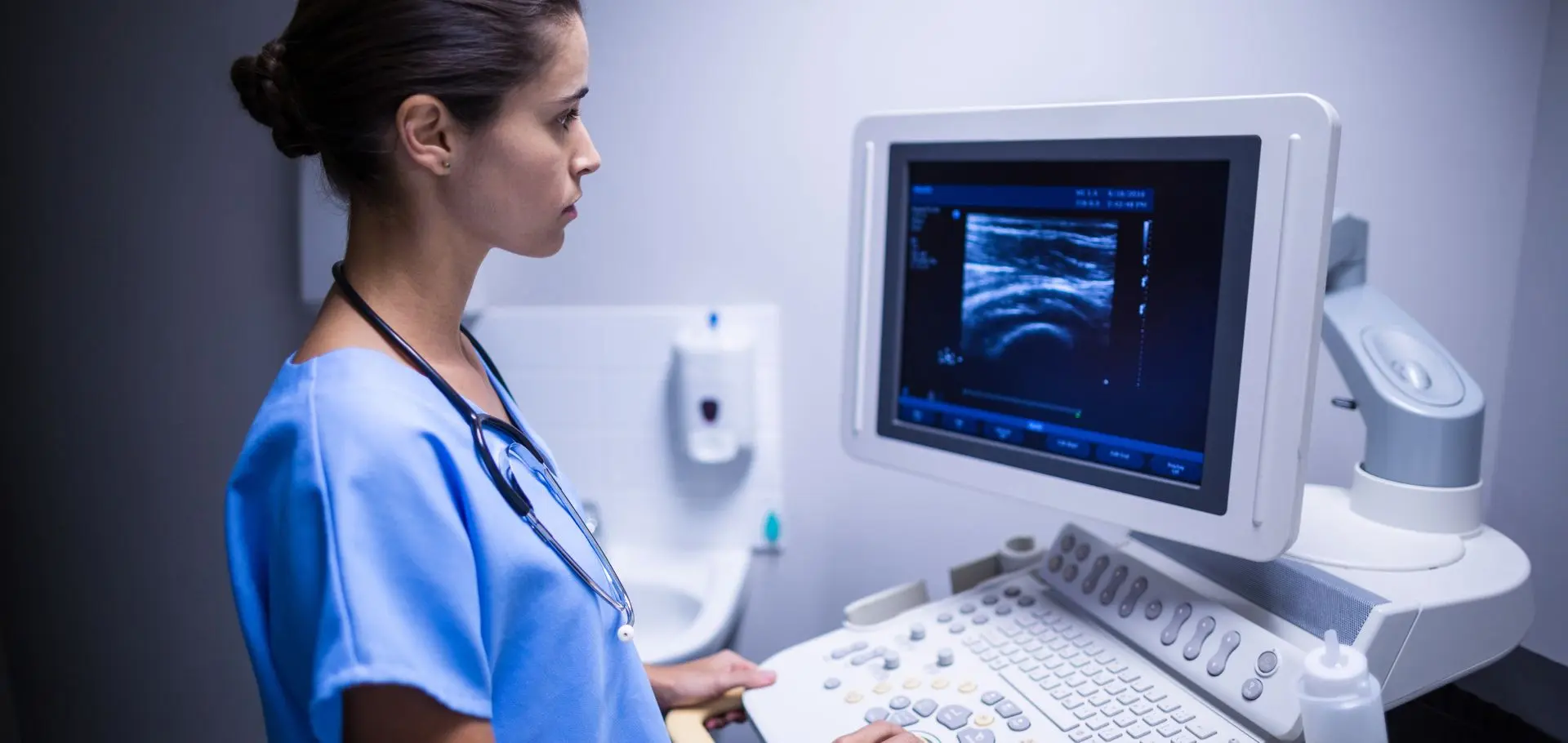
Getting into a diagnostic medical sonography program takes more than interest—it takes strategy. These programs are selective, seats are limited, and admissions committees evaluate every piece of your application. From foundational science courses to clinical observation hours, the prerequisite checklist exists for a reason: to make sure you’re prepared for a career that directly impacts patient outcomes.
Understanding what’s required before you apply, and having a clear plan to get there is what separates competitive applicants from everyone else. Southern California University of Health Sciences (SCU) offers Accelerated Sciences courses that cover the foundational coursework most sonography programs demand, all delivered in a five-week, online format designed for students who need to move efficiently without sacrificing rigor.
Why Sonography Programs Set Prerequisite Standards
Diagnostic medical sonography isn’t a field where you learn on the job. Sonographers work directly with patients, operate sophisticated imaging equipment, and produce images that physicians rely on to make treatment decisions.
Accreditation also plays a direct role. Programs accredited by the Commission on Accreditation of Allied Health Education Programs (CAAHEP) are held to strict educational standards. Completing a CAAHEP-accredited program is the most straightforward path to sitting for ARDMS certification exams—the credential most employers require at the point of hire. Prerequisites exist to protect that pipeline.
Core Academic Prerequisites for Ultrasound Tech Programs
Most accredited sonography programs share a consistent set of required coursework. Specific titles and credit hours vary by school, but the subject areas are nearly universal. Every course typically must be completed with a grade of C or better.
Core Coursework Sonography Programs Expect
While exact course titles and credit hours vary by institution, the subject areas are remarkably consistent across accredited programs. Each course typically must be completed with a grade of C or better at a regionally accredited institution.
Anatomy & Physiology I & II — The backbone of any sonography application. Most programs require these taken in sequence over a full academic year, with each course spanning a minimum of 15 weeks. SCU’s Accelerated Sciences program offers both Anatomy & Physiology I (BIO221) and Anatomy & Physiology II (BIO226) in a fast-tracked format that includes lab credit.
General Physics — Covers wave mechanics, acoustic properties, and the energy principles underlying sonographic imaging. Some programs specifically require coursework that addresses waveforms and acoustics. SCU offers Physics I (PHYS211) and Physics II (PHYS216) online with lab credits included.
College Algebra or Higher — At minimum, programs require college algebra; some prefer pre-calculus or statistics. Math proficiency matters for calculating measurements and interpreting imaging data. SCU’s College Algebra (MATH111) and Statistics (MATH213) are both available online.
Medical Terminology — The clinical language that fills patient records and physician orders. SCU offers both Introduction to Medical Terminology (BIO200) and Applied Medical Terminology (BIO203).
English Composition or Oral Communication — Sonographers write clinical reports and collaborate across care teams daily. Most programs accept Composition I or a public speaking course to satisfy this requirement.
General Biology — Builds foundational knowledge of cellular processes and organ systems that supports more advanced healthcare coursework. SCU’s General Biology I (BIO111) covers this ground with lab credit available.
Degree Pathways Into Sonography
The prerequisite structure shifts depending on the program format you pursue.
Associate degree programs (2 years) represent the most common entry point for students without a healthcare background. Prerequisites may be embedded within the program rather than required upfront.
Bachelor’s degree programs (3 to 4 years) offer a deeper scientific foundation and can position graduates for higher earning potential and advancement. BLS data shows the top 10% of sonographers earn more than $123,170 annually.
Certificate programs (12 to 14 months) are designed for individuals already credentialed in an allied health field. These are highly selective and typically require an existing healthcare credential before admission.
For students building the academic profile that competitive sonography programs look for, SCU offers two degree programs worth considering. The Bachelor of Science in Health Sciences (BSHS) is a fully online degree completion program with concentrations that strengthen your science foundation—including Human Genetics, Functional Anatomy, and Psychology. The Master of Science in Medical Science (MSMS) mirrors the rigor of first-year medical education and is designed to elevate the academic credentials of students preparing for competitive health professional programs. Both programs reflect SCU’s whole health approach to education—one that trains students to see patients as whole people, not just diagnostic images.
Clinical Observation Hours
Shadowing requirements are one area where prospective sonography students often underestimate what’s expected. Programs want to see that applicants have spent real time in a diagnostic imaging setting and understand what the job actually involves.
Requirements vary widely. Some programs ask for as few as 8 to 16 hours of documented observation, while more competitive programs require 30 to 40 or more. Observation must be conducted under the supervision of a credentialed sonographer or physician and documented with a signed verification form on institutional letterhead.
Programs want applicants who have seen abdominal, obstetric, gynecologic, and ideally vascular or cardiac scans. Students who enter without this exposure tend to be caught off guard by the physical pace and demands of clinical environments.
Additional Admission Requirements
Beyond coursework and observation hours, most programs ask for the following before an application is considered complete:
- CPR/BLS Certification — Current American Heart Association Basic Life Support certification, required before clinical rotations begin or at the time of application.
- Background check and drug screening — Standard across all clinical health programs.
- Letters of recommendation — Typically two to three references from instructors, clinical supervisors, or healthcare employers.
- Personal statement — A typed essay describing interest in sonography, relevant experiences, and career goals.
- Immunization and health records — Proof of required vaccinations, TB testing, and a general physical exam before clinical placement.
Degree Options and How Prerequisites Fit In
Sonography programs come in several formats, and the prerequisite structure shifts depending on which path you choose:
- Associate degree (2 years) — The most common entry point for students without a healthcare background. Prerequisites are often embedded within the program rather than required before admission.
- Bachelor’s degree (3 to 4 years) — Offers a deeper scientific foundation and can position graduates for higher earning potential. The Bureau of Labor Statistics reports a median annual wage of $89,340 in May 2024, with projected job growth of 13% through 2034—well above the average across all occupations.
- Certificate programs (12 to 14 months) — Designed for individuals already working in an allied health field. Highly selective; an existing healthcare credential is typically required before admission is considered.
SCU’s Bachelor of Science in Health Sciences and Master of Science in Medical Science offer students rigorous clinical science preparation that builds the academic profile sonography programs look for in competitive applicants.
Why Accreditation Should Drive Your Program Choice
Not all sonography programs are equal. CAAHEP accreditation is the gold standard—graduates of accredited programs are eligible to sit for ARDMS certification exams upon or before graduation.
Without it, a graduate may need to complete a full year of paid, full-time clinical employment before qualifying for certification—a difficult position since most employers won’t hire an uncertified sonographer in the first place. Verify accreditation status directly on the CAAHEP website before enrolling.
Start Building Your Record Now
The strongest sonography applicants don’t wait until a program is in their sights. They finish prerequisites early, earn competitive grades in science courses, log observation hours before deadlines close in, and apply knowing their record can hold up to scrutiny.
SCU’s Accelerated Sciences program was built for this kind of student. With courses spanning anatomy, physics, biology, math, and medical terminology, it covers the full range of what competitive sonography programs look for. Explore the course listing and request information to find out how SCU can help you build the foundation your future program will want to see.
Frequently Asked Questions
What are the most common ultrasound tech prerequisites?
Most accredited sonography programs require Anatomy and Physiology I and II, General Physics, College Algebra, Medical Terminology, English Composition, and General Biology. All courses must typically be completed with a grade of C or better at a regionally accredited institution. Some programs also require that science courses have been completed within the past five to seven years. SCU’s Accelerated Sciences courses cover the majority of these requirements in an online, five-week format.
How many clinical observation hours do I need before applying?
Requirements vary by program. Some ask for as few as 8 to 16 documented hours, while more competitive programs require 30 to 40 or more. Hours must be completed in a diagnostic sonography department under the supervision of a credentialed sonographer or physician, with written verification on official letterhead. Start logging hours early—availability in clinical sites can be limited.
What GPA do I need for a sonography program?
Most CAAHEP-accredited programs require a minimum cumulative GPA between 2.5 and 3.0. Science coursework is frequently evaluated separately at a higher threshold. Since admission is competitive, exceeding the minimum—especially in anatomy, physics, and biology—meaningfully strengthens your position.
Do I need CPR certification to apply?
Many programs require current American Heart Association Basic Life Support (BLS) certification either at the time of application or before clinical rotations begin. Completing this early removes a potential obstacle once you’re accepted.
Can I complete sonography prerequisites online?
Yes. Many foundational courses are available through accredited institutions in online formats. SCU’s Accelerated Sciences program offers anatomy, physiology, physics, biology, medical terminology, math, and more—all online, in five-week sessions, with lab credits included where applicable. Courses carry WSCUC accreditation, making them widely transferable.
What happens if I choose a non-CAAHEP-accredited sonography program?
Graduates of non-accredited programs typically must complete one full year of paid, full-time clinical experience before qualifying to sit for ARDMS certification exams. Since most employers require certification at the point of hire, this creates a significant barrier. Always verify a program’s accreditation status through the CAAHEP website before enrolling.
How does SCU’s Accelerated Sciences program help with sonography prerequisites?
SCU offers more than 35 online courses—including Anatomy & Physiology I and II, Physics I, College Algebra, General Biology I, and Medical Terminology—that align with the requirements of most accredited sonography programs. Each course runs in a five-week accelerated format with continuous enrollment, and all carry WSCUC accreditation. Lab fees and equipment are included in tuition, and credits have been successfully transferred to numerous colleges and universities nationwide.