
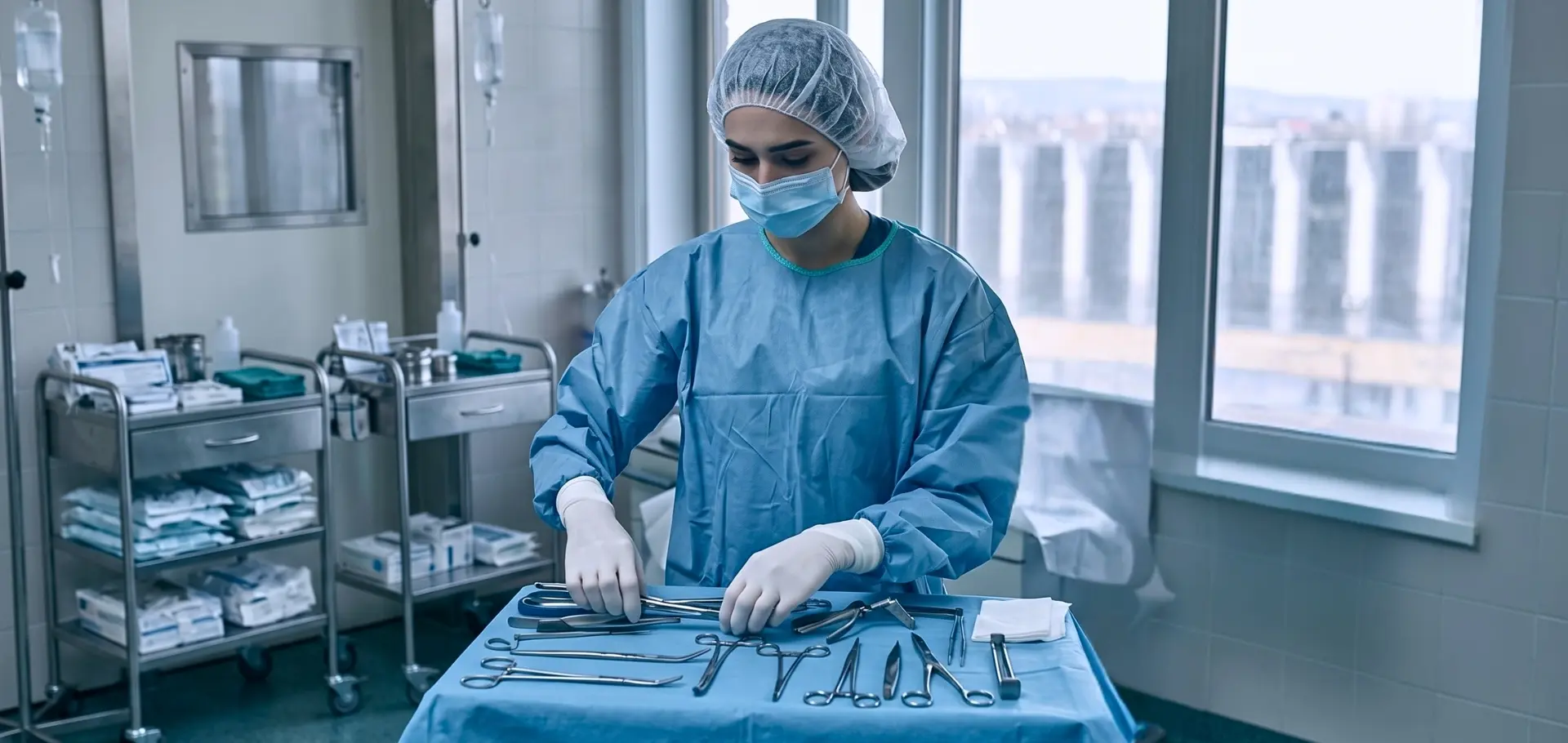
If you’re drawn to the fast-paced environment of the operating room and want a career at the center of life-saving procedures, surgical technology might be your calling. But before you can scrub in, you need to clear one important hurdle: the surgical tech prerequisites that most programs require for admission.
For many aspiring surgical technologists, those science and math requirements become the unexpected obstacle between them and their dream program. Whether you graduated years ago and your transcripts don’t reflect the required coursework, or you’re pivoting careers and starting fresh, you’re not alone and you’re not without options.
SCU’s Accelerated Sciences program is designed specifically for students in this position, offering focused online courses that fit around your life. Here we will explain exactly what surgical technology programs expect and how to position yourself for admission success.
What Are Surgical Tech Prerequisites, Really?
More Than a Checklist: Why Programs Require What They Require
When a surgical technology program lists prerequisites, they’re identifying the foundational knowledge base every incoming student needs before clinical and technical training begins. Surgical tech prerequisites typically include life and physical sciences and sometimes mathematics, because the work of a surgical technologist demands a working understanding of anatomy, physiology, microbiology, and basic chemistry.
The ARC/STSA’s Core Curriculum for Surgical Technology is the national standard that all accredited programs must follow. It identifies anatomy, physiology, and microbiology as foundational competency areas for every entry-level surgical technologist. Programs require these courses because the accreditation standards they must meet demand them.
If you’re currently missing some of these courses, SCU’s Accelerated Sciences program offers an efficient, fully online way to fulfill them on a schedule that works for you.
The Grade That Speaks Before You Do
Surgical technology programs are competitive, and admissions committees use prerequisite performance as one of the clearest signals of a candidate’s readiness. A strong grade in Anatomy and Physiology tells a program you can master dense scientific material under pressure, which is exactly the skill set you’ll need throughout their curriculum.
Beyond admissions, the content of your prerequisite courses directly informs your success in the program itself. Students who arrive with a solid science foundation tend to move through technical coursework more confidently.
If your earlier coursework feels distant or was completed under difficult circumstances, refreshing that knowledge with a targeted online course is worth considering before you apply.
The Courses That Open the OR Door
The Big Three: Anatomy, Physiology, and Microbiology
The non-negotiable core of surgical tech prerequisites centers on three subject areas that map directly to what you’ll do in the OR every day.
Anatomy and Physiology
These courses are required by virtually every accredited surgical technology program. It’s typically offered as a two-course sequence. A&P I covers foundational concepts like cell biology, tissues, the skeletal system, and the muscular system, while A&P II moves into the nervous, cardiovascular, respiratory, digestive, and reproductive systems.
Some programs accept standalone Human Anatomy and Human Physiology courses in place of the combined sequence. SCU offers all four options: Anatomy & Physiology I, Anatomy & Physiology II, Human Anatomy, and Human Physiology. Each is completable in five weeks and available with lab credit.
Microbiology
This is required by the majority of programs and is arguably the most directly relevant science course for surgical technology. A working knowledge of bacterial and viral pathogens, infection mechanisms, and antimicrobial principles is foundational to aseptic technique and surgical site infection prevention. SCU’s Microbiology course covers these topics with lab credit available.
Beyond the Big Three: Chemistry, Biology, and Math
Beyond A&P and microbiology, many surgical technology programs require at least one additional science or math course, and the specifics vary more widely here.
Chemistry
Chemistry requirements depend on the program level. Many associate-degree programs require a one-semester introductory chemistry course. SCU offers several options depending on where you’re starting:
- Intro to Chemistry – a foundational entry point for students with little to no prior chemistry background
- Chemistry for Health Sciences – covers chemical principles in a healthcare context, well-suited for programs that want applied science content rather than general chemistry
- General Chemistry I – for programs that specify a standard college-level chemistry course, available with lab credit
General Biology
Biology may be required by programs that want a broader life sciences foundation before students move into specialized clinical training. SCU offers multiple entry points:
- Human Biology I and Human Biology II – focused on the human organism, these courses are a natural complement to A&P for surgical tech applicants
- General Biology I and General Biology II – broader in scope, covering foundational life science concepts; both available with lab credit
Math
Requirements for math courses, where listed, are typically at the college algebra level or below. SCU offers a clear progression depending on your starting point:
- Intermediate Algebra – for students who need to build toward college-level math
- College Algebra – satisfies the math requirement most programs list
- Statistics – relevant for programs that require a quantitative reasoning or stats course rather than algebra
The Details That Catch Applicants Off Guard
Medical Terminology: Do You Need It Before You Apply?
One course that generates consistent confusion is medical terminology. Many surgical technology programs list it as a requirement, but a meaningful number classify it as a co-requisite rather than a prerequisite, meaning you can complete it during your first term rather than before you apply.
This distinction matters for your timeline. If medical terminology is a co-requisite at your target program, you don’t need to finish it before submitting your application.
That said, completing it early has real advantages. Surgical technology coursework is dense with Latin and Greek roots, anatomical directional terms, and procedure-specific vocabulary, and arriving fluent in that language accelerates your learning considerably.
SCU offers both Intro to Medical Terminology and Applied Medical Terminology online. Check which level your target program expects and plan accordingly.
Will Programs Accept Your Online Coursework?
A common question from adult learners and career changers is whether surgical technology programs accept online prerequisite coursework. The answer for most is yes, provided the courses come from a regionally accredited institution.
Southern California University of Health Sciences is accredited by the WASC Senior College and University Commission (WSCUC), which means credits earned through the Accelerated Sciences program meet the baseline standard that health science programs typically require.
It’s also worth noting that ARC/STSA requires that any institution hosting a CAAHEP-accredited program hold appropriate institutional accreditation. That’s why credits from regionally accredited institutions like SCU are recognized where others may not be.
Where programs sometimes add scrutiny is around lab components. Some require that courses like Microbiology or Anatomy and Physiology include a laboratory element. SCU’s courses in these subjects are available with lab credit, which addresses this requirement directly.
The Expiration Date on Your Old Science Credits
One of the most commonly overlooked details in the application process is the recency requirement. Most programs require that your science coursework was completed within a defined window, typically five to seven years before your application date.
Transcripts showing anatomy or microbiology credits from a decade ago will often not satisfy this requirement, regardless of the grade earned.
This catches career changers off-guard more than almost any other admissions detail. If you completed science courses years ago during a prior degree, you may need to retake them. SCU’s Anatomy & Physiology I and Microbiology courses are a practical way to refresh and fulfill outdated credits on a timeline you control.
How Much Your Prerequisite GPA Matters
Your grades in prerequisite courses carry real weight in surgical technology admissions. Many programs set minimum GPA thresholds, commonly a 2.5 to 3.0 on a 4.0 scale, and programs at the more selective end may favor candidates who exceed those minimums considerably.
Anatomy and Physiology tends to be weighted most heavily, as it’s the most direct predictor of clinical curriculum performance.
If you have older or lower-performing grades on your transcript, retaking relevant courses through SCU’s Accelerated Sciences is a concrete way to strengthen your profile before the next application cycle.
Why SCU Students Arrive Ready
Credits That Go Where You’re Going
Southern California University of Health Sciences (SCU) is regionally accredited by WSCUC, which means courses completed through its Accelerated Sciences program are recognized by health science programs when evaluating prerequisite credits.
Students completing prerequisite requirements at SCU can do so knowing the credits will meet the expectations most programs apply. Learn more about SCU’s accreditation and institutional affiliations.
Built for People Who Can’t Put Their Lives on Hold
SCU’s Accelerated Sciences program was built with working adults and career changers in mind. Courses are fully online and asynchronous, start every five weeks, and can be completed in as little as five weeks each, which is a significant advantage over traditional semester-based timelines.
For prospective surgical technology students juggling jobs, families, and application deadlines, that flexibility can be the difference between making an application cycle and missing it entirely. Explore the full course catalog at SCU Accelerated Sciences.
Your Path Into the OR Starts Here
Surgical technology is a high-demand, high-stakes field, and programs are selective for good reason. According to the Bureau of Labor Statistics, the field is projected to grow 5% through 2034, faster than the average for all occupations, with approximately 8,700 job openings expected each year over the next decade. That growth keeps applicant pools strong and raises the bar for who gets in.
The surgical tech prerequisites programs require aren’t red tape; they’re the foundation on which every skill you’ll develop is built. Understanding exactly what’s required, getting the right coursework in order, and presenting a competitive application are the steps that separate candidates who get in from those who don’t.
If prerequisite coursework is the piece of your application that needs attention, consider exploring SCU’s Accelerated Sciences program as your path forward. Courses are available online, start every five weeks, and are designed to meet the expectations of health science programs nationwide.
Take the first step: review SCU’s available prerequisite courses and build your plan for program admission today.
Frequently Asked Questions
What should I look for when comparing surgical technology programs before I apply?
Accreditation is the first filter. Any program you seriously consider should be CAAHEP-accredited, since that status is required to sit for the CST exam and is the credential most employers use to evaluate candidates.
Beyond that, look closely at program outcomes data, specifically the first-time CST exam pass rate and the job placement rate for graduates. CAAHEP-accredited programs are required to report this data annually, and programs with strong outcomes will typically make it easy to find.
You should also evaluate the clinical rotation structure. Surgical technology is a hands-on field, and the range and volume of procedures you’re exposed to during clinical training has a direct impact on how prepared you’ll feel entering the workforce. Ask programs specifically about the number of required clinical hours and the types of facilities where rotations are completed.
Is there a minimum grade required in prerequisite courses, and does it vary by program?
Most surgical technology programs specify a minimum grade of C or better in each prerequisite course, and some raise that bar to a B in core science courses like Anatomy and Physiology.
Importantly, earning the minimum passing grade doesn’t necessarily mean the course satisfies the prerequisite. Some programs will accept a C for enrollment but will not count it toward the prerequisite requirement for selective admission scoring.
This distinction matters most at programs that use a points-based or ranked selection process. In those systems, your prerequisite GPA isn’t just a threshold to clear; it’s actively scored against other applicants. A C in Microbiology may technically satisfy the requirement while quietly costing you ranking points that a stronger applicant will use to move ahead of you in the selection pool. Aim higher than the minimum whenever possible.
What’s the difference between Intro to Medical Terminology and Applied Medical Terminology?
Introductory medical terminology courses focus on building a working vocabulary from the ground up, covering Greek and Latin roots, prefixes, suffixes, and the rules for constructing and decoding clinical terms. Applied medical terminology goes a step further, contextualizing that vocabulary within actual clinical settings and specialty areas like surgery, cardiology, and orthopedics.
For most surgical technology programs, an introductory course will satisfy the terminology requirement. Applied medical terminology is worth considering if you want a stronger clinical foundation going into the program, or if your target program specifies a higher-level course.
Both Intro to Medical Terminology and Applied Medical Terminology are available through SCU’s Accelerated Sciences program.
How recent do my prerequisite courses need to be?
The five-to-seven year recency window is standard, but there’s an important nuance worth knowing: some programs count it from the date you begin the program, not the date you apply. That distinction can shift your planning by a full year in either direction.
If you’re applying now but won’t start until next fall, a course completed six years ago might clear the window at application but expire before your first day of class.
The safest approach is to contact each program’s admissions office directly and ask how they calculate the recency window. Getting that answer in writing protects you from a last-minute surprise that could delay your enrollment by an entire cycle.
What is shadow experience, and do surgical technology programs require it?
Job shadowing means spending time observing a working surgical technologist in an active operating room. It is not universally required by surgical technology programs, but it is strongly encouraged and sometimes formally evaluated as part of the application. Some programs ask applicants to submit a shadowing verification form or a written reflection on what they observed.
Beyond the application, shadowing serves a practical purpose: the OR environment is unlike any other clinical setting, and exposure to it before you commit to a program helps you confirm the role is a genuine fit.
Candidates who have shadowed tend to write more grounded personal statements, answer interview questions more specifically, and arrive on day one with realistic expectations of what the work actually involves.
Is the CST exam required to work as a surgical technologist?
The CST exam, administered by the National Board of Surgical Technology and Surgical Assisting (NBSTSA), is not universally required by law. In practice, though, most hospital employers and surgical centers expect it. Several states have also moved toward requiring licensure or certification as a condition of employment, and that trend is continuing.
Beyond employment, maintaining CST certification requires ongoing continuing education. Certified surgical technologists must earn a set number of continuing education credits during each renewal cycle to keep their credential active.
This means your education doesn’t stop at graduation. Staying current with developments in surgical techniques, sterile processing, and patient safety standards is a built-in part of the profession from the moment you’re certified.
Can surgical technology serve as a stepping stone to other healthcare roles?
Yes, and this is one of the more underappreciated aspects of the field. Surgical technologists who want to advance have several well-established pathways available to them. The most direct is becoming a Certified Surgical First Assistant (CSFA), a more advanced role that involves actively assisting the surgeon during procedures rather than primarily managing the sterile field and instrumentation.
Others use surgical technology as a foundation for broader clinical careers, pursuing nursing, physician assistant studies, or other allied health programs with the benefit of significant hands-on OR experience already behind them.
That real-world clinical background can strengthen applications to competitive graduate programs and gives career changers a meaningful advantage when articulating their readiness for advanced training.